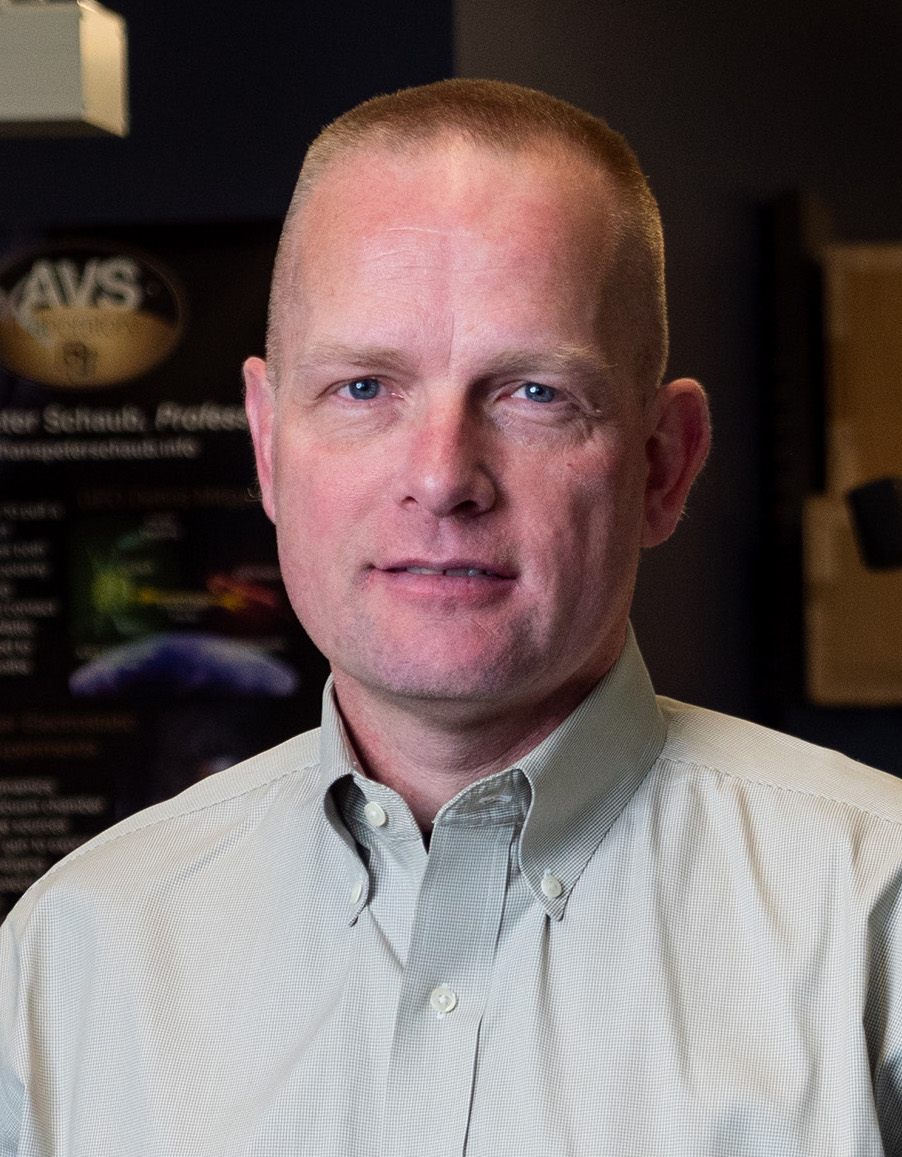
Dr. Schaub's research continues in the field of electrostatic actuation of space objects, attitude kinematics, momentum based attitude control, higher level spacecraft autonomy, as well as relative motion simulation, sensing and control. His AVS Lab obtained a vacuum chamber in 2016 for charging experiments. This was expanded with the help of a DURIP grant to become the current ECLIPS chamber for charged astrodynamics research. He researches autonomous spacecraft tasking with on-board shielded neural networks, constrained attitude control, the equations of motion of complex spacecraft dynamics with flexing, slosh and unbalanced wheels, as well as flight software architectures. A strong emphasis has become the electrostatic detumbling of passible space objects, as well as autonomous attitude control and momentum management. New recent research includes using shielded deep reinforcement learning techniques to create artificial neural networks that enable autonomous spacecraft flight mode targeting. He is also heavily engaged with the development of the Basilisk astrodynamics simulation framework. He is the lead developer and manages the code repo and continuous integration servers.
keywords
astrodynamics, spacecraft formation flying, spacecraft attitude dynamics and control, nonlinear dynamics and control, relative motion sensing, electrostatic actuation in a space environment, charged vacuum and plasma chamber experiments, astrodynamics software architecture, mission analysis and support, spacecraft autonomy, spacecraft simulation architectures, on-board spacecraft neural networks.
ASEN 5010 - Spacecraft Attitude Dynamics and Control
Primary Instructor
-
Spring 2018 / Spring 2019 / Spring 2020 / Spring 2024
Includes rigid body kinematics and spacecraft attitude descriptions, torque-free attitude dynamics, static attitude determination, motion and stability due to gravity gradient torque and spinning craft, passive and active methods of attitude control, nonlinear regulator and attitude tracking feedback controlaws. Recommended prerequisite: ASEN 3200, ASEN 3700, or equivalent and good knowledge of linear algebra, vector calculus, basics of ordinary differential equations.
ASEN 6010 - Advanced Spacecraft Dynamics and Control
Primary Instructor
-
Fall 2018 / Spring 2019 / Fall 2021 / Fall 2023 / Summer 2025
Studies the dynamic modeling and control of spacecraft containing multiple momentum exchange devices, and/or flexible spacecraft components. Will develop nonlinear feedback control algorithms, explore singularity avoidance strategies. The second half of the course derives analytical methods (D'Alembert's equations, Lagrange's equations, Boltzmann Hamel equations) to model a hybrid rigid/flexible spacecraft system.
ASEN 6014 - Spacecraft Formation Flying
Primary Instructor
-
Fall 2019 / Spring 2023 / Spring 2024 / Fall 2025
Studies the dynamic modeling and control of spacecraft formations orbiting about a planet. Investigate linear and nonlinear relative motion descriptions, rectilinear and curvilinear coordinates, orbit element difference based descriptions, J2-invariant relative orbits, as well as Lyapunov-based relative motion control strategies.