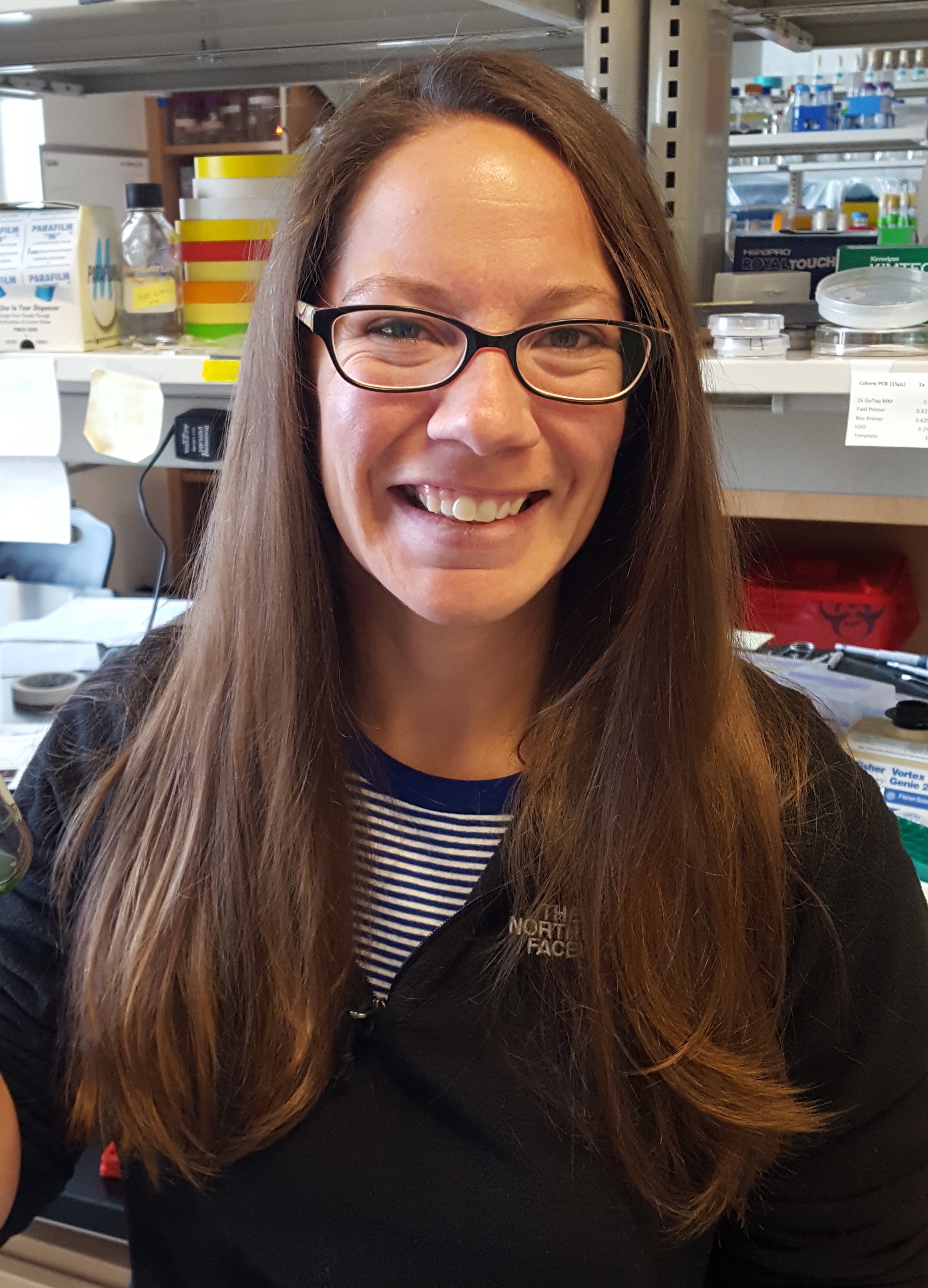
My research focuses on gaining insights into how photosynthetic microbes, specifically cyanobacteria, can be efficiently and economically harnessed as a platform for renewable resource generation. I am interested in determining how genome content and replication impact cyanobacterial physiology and in designing synthetic biology tools that can be introduced into these microbes to create finely tuned genetic circuits
MCDB 3010 - Undergraduate Teaching in Course-Based Undergraduate Research Experiences
Primary Instructor
-
Fall 2023 / Spring 2024 / Fall 2024 / Spring 2025 / Fall 2025 / Spring 2026
To address the need for more advanced and continued participation in course-based research, MCDB 3010 is designed to train students who have taken MCDB 1171 or MCDB 2171 or MCDB 4202 as teaching assistants. The aim is to enhance the students' experience and responsibilities in course-based research and to prepare them for research and mentorship in a departmental or graduate laboratory. May be repeated up to 4 total credit hours.
MCDB 3020 - Next Steps: Preparing for Life After Graduation
Secondary Instructor
-
Spring 2026
Helps upper-division students prepare for what comes after graduation. Topics include exploring careers; how to write a resume or CV; interviewing tips; how to build your portfolio; asking for letters of recommendations. This course is specifically designed for juniors starting to prepare for the next stage post-graduation. Same as EBIO 3020 and IPHY 3020.
MCDB 3140 - Cell Biology Laboratory
Primary Instructor
-
Fall 2020 / Spring 2021 / Fall 2021 / Spring 2022 / Fall 2022 / Spring 2023 / Fall 2023 / Spring 2024 / Fall 2024
Provides laboratory experience using microscopy, bioinformatics, DNA isolation, PCR and gel electrophoresis to study cell biology and gene expression in a model organism. Students will learn research skills such as interpreting data and planning experiments. Recommended corequisite: MCDB 3135 or MCDB 3145.
MCDB 4410 - Human Molecular Genetics
Primary Instructor
-
Fall 2025 / Spring 2026
Studies the human organism as a genetic system, including effect of mutation on protein structure and function, biochemical basis of human genetic disease, polymorphic gene loci, gene mapping and identification, gene cloning and characterization, and impact of human genetics on medicine and society. Fulfills MCDB scientific reasoning requirement. Recommended prerequisite: MCDB 3135 (minimum grade C-).
MCDB 4444 - Cellular Basis of Disease
Primary Instructor
-
Spring 2024 / Fall 2024 / Fall 2025 / Spring 2026
Explores the cellular basis of disease. Discusses diseases arising from defects in intracellular targeting, cytoskeletal function, intracellular signaling, genomic instability, gene regulation, cell proliferation, and cell death. Involves student-organized presentations and classroom discussion. Fulfills MCDB scientific reasoning requirement. Recommended prerequisites: MCDB 3135 and MCDB 3145 (minimum grade C-).
MCDB 4845 - Internships in MCDB
Primary Instructor
-
Spring 2026
Provides an opportunity for students to gain research experience outside of the CU Boulder setting through internships at outside companies or institutes. Internship experiences allow students to connect course content to real world learning, while also engaging with a diverse community of professionals. May be repeated up to 6 total credit hours. Recommended restrictions: students with 60-124 credit hours.
MCDB 4990 - Honors Thesis
Primary Instructor
-
Spring 2022
Involves the preparation and defense of an honors thesis, based on faculty-supervised original research, including final phases of the research project. Recommended prerequisites: MCDB 4840 or MCDB 4980 or comparable research experience, and minimum GPA of 3.3 and approval by the MCDB Honors Committee.
MCDB 6000 - Introduction to Laboratory Methods
Primary Instructor
-
Spring 2022
Introduces methodology and techniques used in biological research. Designed as a tutorial between a few students and one faculty member. Students are expected to read original research papers, discuss findings, and to plan and execute experiments in selected areas. May be repeated up to 15 total credit hours.